When evaluating a spiral freezer, one of the first questions is usually how many kilograms of product it can process per hour.
Capacity is certainly important, but a single throughput figure rarely tells the complete story. The same freezer may perform differently when processing bread, poultry products, prepared meals or packaged food.
Understanding the relationship between belt speed, residence time and product loading is essential when selecting a freezing system for continuous production.
What determines spiral freezer capacity?
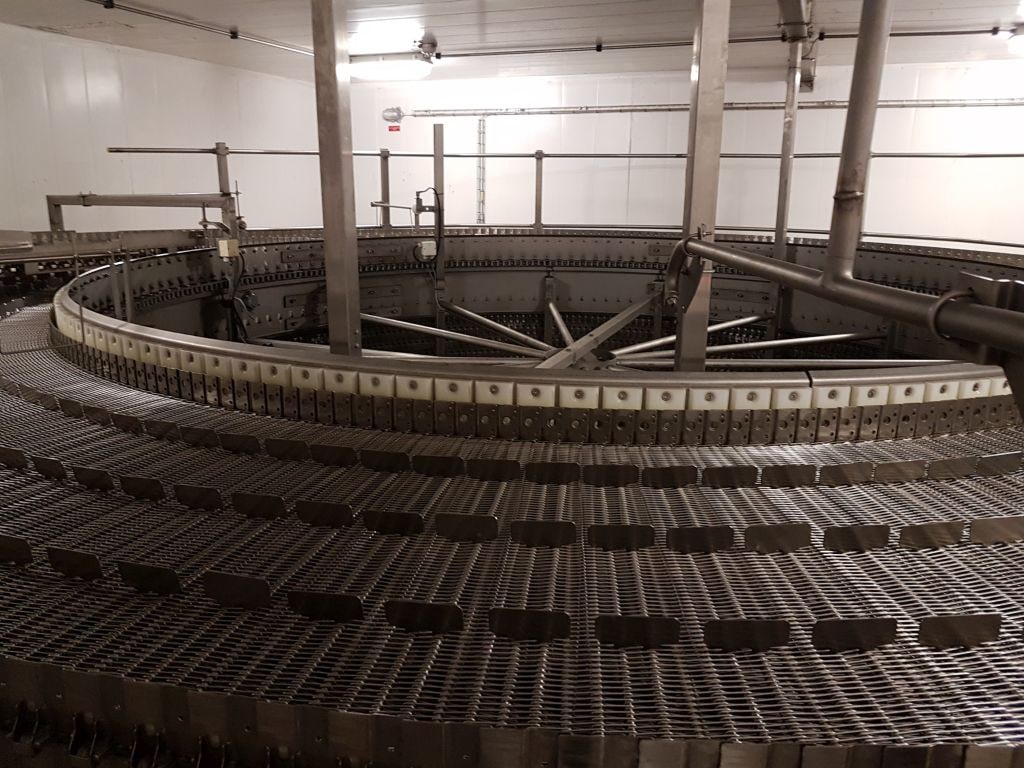
A spiral freezer uses a continuous conveyor belt that travels through an insulated freezing enclosure.
The product enters the system, remains inside for a defined period and exits after reaching the required process condition.
The freezer’s practical throughput depends on several factors, including belt dimensions, conveyor speed, product loading, refrigeration capacity and airflow.
Product characteristics are equally important. Two products with the same weight can behave very differently during freezing.
For example, a thin item generally presents different heat-transfer conditions from a thick, densely packed product.
Understanding residence time
Residence time is the period that a product spends inside the freezer.
It is related to the effective conveyor length and belt speed. As a simplified example, a freezer with 300 metres of usable belt operating at 5 metres per minute provides approximately 60 minutes of conveyor travel time.
However, this does not mean every product will be sufficiently frozen after one hour.
The required residence time depends on the product’s initial temperature, dimensions, composition, loading arrangement and target core temperature.
These variables should be evaluated before confirming a machine’s capacity for a particular application.
Belt width and product loading
A wider conveyor belt can provide more space for products, but only when the loading arrangement and airflow are suitable.
Some products can be distributed relatively evenly across the belt. Others require spacing to avoid sticking, deformation or uneven freezing.
Packaged ready meals, for example, may need a different loading pattern from loose bakery products.
The usable belt width is also more relevant than the nominal width in some applications.
When comparing used spiral freezers, examine the net belt width, product clearance and permissible belt loading rather than relying only on the advertised capacity.
Refrigeration power is another limiting factor
Increasing the belt speed does not automatically increase the amount of properly frozen product leaving the machine.
If the refrigeration system cannot remove heat quickly enough, products may exit above the desired temperature.
The evaporator design, airflow distribution and available refrigeration capacity must support the intended production rate.
This is why a freezer’s mechanical conveyor specifications should always be considered alongside its thermal performance.
A practical example from industrial equipment
Industrial Freezing lists various spiral freezers with substantially different specifications.
For instance, its Frigoscandia GyroCompact M106 spiral freezer has a large effective belt area and substantial installed cooling capacity.
These specifications are relevant when considering high-throughput production. However, the achievable capacity for a specific food product still requires technical evaluation.
An advertised cooling capacity should never be treated as a guaranteed product throughput without further assessment.
Why product testing matters
When production volumes are high, even a small difference between expected and actual capacity can have major consequences.
It may affect upstream production, packaging schedules, staffing and cold storage requirements.
Where possible, use existing operating data, product calculations or representative tests to verify that the proposed freezer can achieve the required result.
A properly matched machine must deliver not only the desired throughput but also consistent product quality.
Choosing the right capacity
Before purchasing a spiral freezer, establish the required kilograms per hour, product dimensions, infeed temperature and target core temperature.
Also consider whether production volumes are expected to increase.
By sharing these details with a specialist, it becomes easier to identify suitable equipment.
Explore the available industrial spiral freezers or contact Industrial Freezing to discuss a system that matches your production requirements.